
_edited.png)
The Beginning of Cinema
- Hrithika Nair

- Mar 5, 2023
- 2 min read
Updated: Mar 26, 2023
To understand anything in this world, you need to start first at its roots. It is nearly impossible to understand cinema as it is today without knowing how we got to this point. Only when you understand the process, the time and the minds that went into the creation of these visual masterpieces we see today can we truly appreciate what lies in front of us.
Generally, Edison is one credited with the major breakthrough in the invention of film. Even the Lumiere brothers might come to mind, with their “La Sortie des ouvriers de l’usine Lumière” (Workers leaving the Lumiere factory). These are the names that went down in history as the firsts to create films. However, in the shadows lay names that were actual breakthroughs in the field, Eadweard Muybridge and Louis Le Prince.
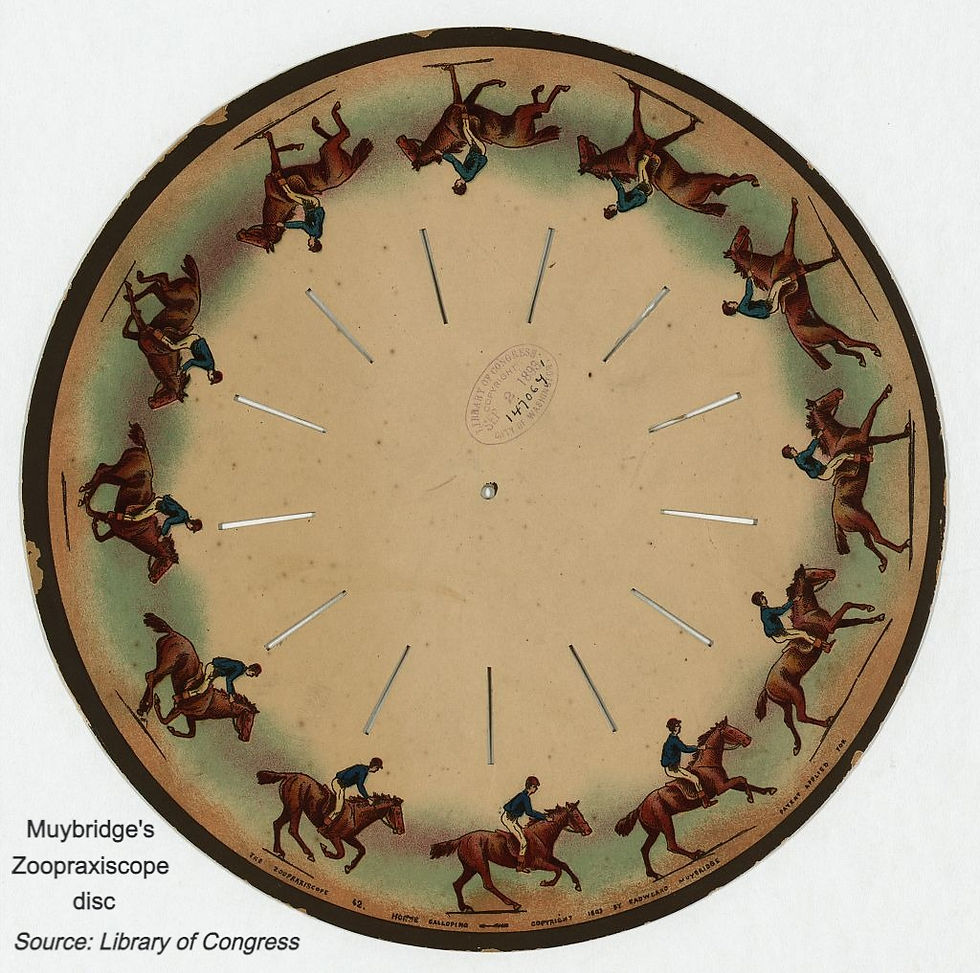
The First Movie
Often a topic of debate, there are differing opinions as to which was the first movie ever made. That depends on the definition that you give to the word “Movie”. If you consider it just as an amalgamation of moving pictures, then the credit here goes to Eadweard Muybridge, and his work with his work on “The Horse in Motion” (1878), a series of images in quick succession that captured a galloping horse (much like modern burst photos). These images were then reproduced on a circular glass plate, called a zoopraxiscope disc. Muybridge was so successful, that he even managed to reproduce colour images, by having artists fill in the glass disc images with coloured paint. However, one can argue that Muybridge’s work of motion picture is precisely that. Multiple pictures in motion, and doesn't quite constitute a “film”.
The Other First Movie

10 years later, enter Louis Le Prince, French inventor who probably had the most relevant breakthrough in cinema. In 1888, using a single lens camera that he built himself, Le Prince captured a scene of people walking in a garden, known today as “Roundhay Garden Scene”. Just a couple of seconds long, and consisting of 20 original frames, this was innovation at its peak. Le Prince’s technique inspired thousands, namely Edison and the Lumiere brothers, and was used for years to come. Tragically, Le Prince was never recognised due to his mysterious disappearance during a train journey. (Conspiracy has it that unsurprisingly, Edison was involved in his disappearance)
The Proper First Movie (The last of the firsts, I promise)
Contrary to the title, this wasn’t the first movie ever made. However, it went down in history as one of the first, and considering cinema in a more modern sense, this can be credited as the first proper movie made, with a cast, story and even cuts. In 1903, Edwin Porter created the film “The Great Train Robbery”, a 13 minute long movie, showing two outlaws attacking a railroad office to rob a train. While maybe not the first, it definitely received popularity in pop-culture for being the first. The movie has had such a strong cultural impact and influence on cinema, that it was even referenced by Martin Scorsese in “Goodfellas” (1990).
Needless to say, the origins of cinema are deeply rooted in history, and the fact that they still hold so much cultural significance is a true testament to the art.


Comments