
_edited.png)
Joyland: Review and Technique
- Vanij Choksi

- Mar 7, 2023
- 5 min read
Updated: Mar 26, 2023
Dir. Saim Sadiq
Punjabi/Urdu
Pakistan, 2022
There’s a place beyond the high-rises, that’s barely visible protruding from atop many a skyline terraces. At night, its neon lights make silhouettes of skyscrapers. Tucked away, its joyous sounds, however, can be heard from a great distance, oftentimes drowning out the noisy traffic of a bustling city. It cannot be seen, although, it does beckon. One must make the trip through the city’s suffocating alleyways to discover for oneself. This is Joyland. A place everyone’s familiar with, it may even be right around the corner of the street you live in, but a place nonetheless, that no one’s ever fully experienced. Until now.

For writer/director Saim Sadiq, Joyland was found ten minutes away from his childhood home in Lahore. For him, Joyland represented the discovery of the transgender community at which time eluded his childish knowledge. His understanding of the evocative world he had come to know has evidently remained with him all these years hence, reflecting in his 2019 short “Darling” and his feature debut, last year’s “Joyland”.
Co-written by Sadiq, Joyland follows Haider, an unsure, unemployed young man, whose role in his quintessential patriarchal, South-Asian family is introduced to us as, what this Pakistani society would deem quite effeminate. He looks after his brother's four children, cooks, irons shirts, etc. He’s constantly told in as many words to “be a man”, however, his friend sets him up as a background dancer for a transgender erotic-theatre performer, Biba. A job, he’s aware if made public, is sure to bring shame on his reputable family.
Although the film has been set up as a trans-drama, it ends up playing out more as an ensemble, family drama. While Haider serves as our guide into the frenzied and confusing world of sexual awakenings and romance, we can see these problems slowly spread throughout the family, to his elder brother, sister-in-law, wife, and even his 70-year-old father, the stoic patriarch. The film also ruminates within the hushed, emotionless characteristics of a Pakistani family cramped together in a small house with tall courtyards. A scalpel taken to what social restrictions come in the way of wanting love on one's own terms, this film is emotionally fraught with stunted external expression and dominated by indicative looks and glances.
What I find particularly interesting in the film's storytelling, which made it so riveting, is its treatment. What's evident is Sadiq’s clear intention as a filmmaker, for his decisions come off as precise and emotionally yielding or un-yielding in certain instances, more on that later.
1. The Suffocating Household
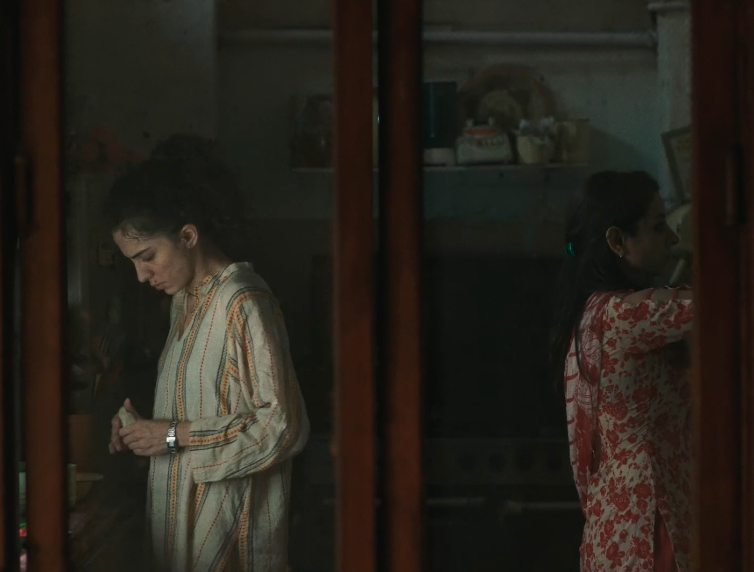
The thought of having nine people, including four children, sharing a home is a suffocating supposition. During pre-production, Sadiq and his cinematographer Joe Saade discussed their affection towards the academy aspect ratio (4:3 or 1.33). Its characteristically boxy frame is perfect for expressive close-ups and avoids the accommodation of extensive negative space within a frame. Moreover, the filmmakers accentuate this homely claustrophobia for the aspect ratio seems tailor-made to fit the all-encompassing frames of the house, which means shooting through doorways, windows, alleys, and staircases to translate the characters' societal entrapment. The edges of the doorways and windows settle onto the seams of the frame, a perfect fit. Nothing lies outside the frame, nothing matters, we’re just forcefully made to see how stuffy and enclosed the house makes everyone look. A smart use of the beautiful academy ratio.
2. Detail Shots
The overall style of this film, as a casual viewer would put it, is “quite slow”. The term that I’d prefer is “visual economy”. The filmmakers are able to communicate vast arrays of emotions with oftentimes one single shot that tells us everything we need to know about how the characters feel without ever overtly expressing it. This approach sits well within the context of the script since no feeling is ever brought up by the characters due to their emotional inability. In my view, this is done by employing a technique that’s made popular by the Scottish director Lynne Ramsay’s visual style, called “Detail Shots”. Most of these “detail shots” gain meaning within context, however, for explanation's sake take this frame for example:

This shot comes at a time in the film when Haider is exploring his sexuality and begins to fall for Biba. He returns home late at night after a close sexual encounter with Biba and lies down next to his wife, Mumtaz. The entire scene plays out in this shot which is very self-referential, it is aware of the effect it has on its viewers. That’s what makes it so descriptive. Placing the camera in this position pushes you as an audience member to view it objectively and critically. Here, given the frame’s peculiar choice, Sadiq is asking of you to make the leap from casual to conscious viewer and ascribe meaning to the image. We infer that this shot echoes their growing inability to communicate since their faces lie cut out of frame. We’re meant to contemplate the space between them. No indication as such is mentioned in the dialogue, for they talk about a completely unrelated topic in this scene, however, the self-conscious detailing choice in this image shows more than the script can ever tell. The film is interspersed with such directorial choices.
3. Exit Early. Exit Early. Enter. Then Stay.
There’s a classic saying in screenwriting “Enter late, exit early” meaning as a writer you should aim to enter scenes late to create a sense of mystery, as to what just occurred, and exit scenes early to leave the audience wanting more. Sadiq and co-writer Maggie Briggs avail their artistic leeway to make a twist on this concept. In its execution, it feels almost Bressonian, but not quite. Robert Bresson's films are characterized by minimal emotions and no music throughout the majority of the film’s runtime, however, towards the end, BANG, a burst of emotions and blaring brass organs. When you’ve spent 90 minutes with no expression what does it make you feel when finally those emotions arrive?
The filmmakers of Joyland may not have consciously set out to put
Bresson’s ideology to the test, but the results are quite similar. As mentioned earlier, Sadiq’s scenes are oftentimes emotionally unyielding due to everyone’s hushed emotions under the presiding patriarchy. When instances of societal wrongdoings are inflicted upon certain characters, the film decides to cut away without allowing us an insight into that character's reaction. Scenes end abruptly without any emotional closure. What that means for us as audience members, is our expectations for these scenes are glutted and we carry these pent-up emotions with us as the film progresses. Finally, when the emotions do surface, Sadiq makes the wise choice of lingering on it for a long while, the entire third act is emotionally relentless, quite uncharacteristic for the film we had been watching. Therefore, like the characters, we too are asked to let out all the rage we have stored within us throughout the film up until that point. In a deft act of empathy, Sadiq has invited us into the lives of his characters.


Comments